
Refer a Patient, Get the Map Back
A brain map and a written summary at intake and again at completion, on a signed release.
For patients whose attention, sleep, or stress load is limiting the care you already deliver.

What You Get Back on Every Referral
At intake, each patient completes a QEEG brain map, and we write a plain-language summary of what the recording shows.
At the end of the training course, we repeat the map and write a second summary covering what moved. On a signed release, the map summaries route directly into the patient's chart.
That gives you two reads on the same patient, on the same measures:
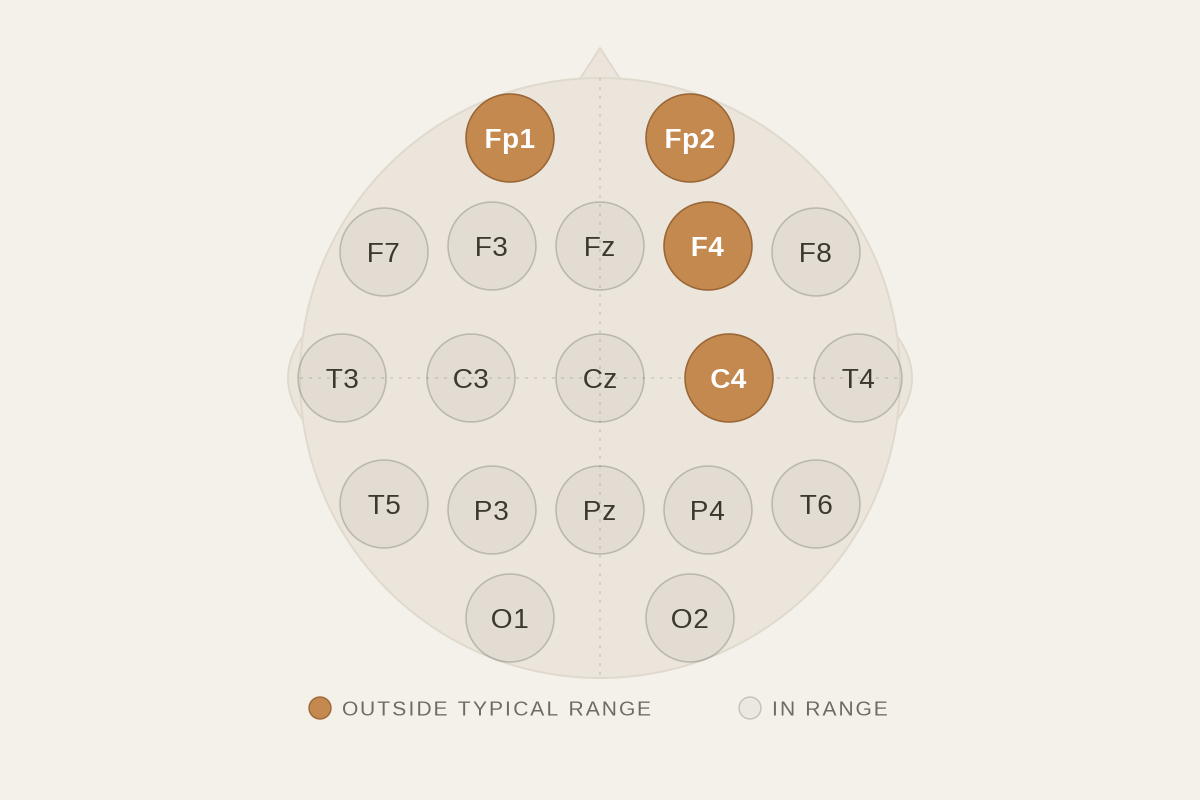
At Intake
A brain map and a written summary of the activity we recorded.
At Completion
A second map, formatted for side-by-side comparison with the first, and a written summary of progress.
Your referral stays visible to you from the first session through the last.
How the Training Works, in Clinical Terms
Neurofeedback records EEG activity and reflects it back to the patient in real time. The QEEG brain map places that activity against normative ranges. During a session, the patient watches a signal driven by their own EEG and practices moving it toward steadier patterns, repeated across a course of sessions.
The system records and reflects. Nothing is administered. No current and no substance is introduced.
The patient's own brain does the work of adjusting, session over session.

Who Is a Good Fit to Refer
Consider a referral when attention, sleep, or stress load is limiting the care you are already delivering. The evidence base for neurofeedback runs strongest in some of these areas and remains emerging in others, so we train inside the lanes where it is best supported:
- Attention and focus that interferes with daily function, including ADHD support alongside the care you provide.
- Stress load sitting underneath the presenting complaint.
- Sleep regulation.
- Memory and decision-making, where short-term recall and day-to-day judgment are affected.
Our Boundaries and Commitments
Training runs alongside whatever care your patient/client already receives from you and their other providers. It supports that care and replaces no part of it.
A few boundaries we state to every referring clinician up front:
- A brain map is a plain-language picture of recorded activity. It produces no diagnosis and replaces no medical evaluation.
- We describe the work as training that runs alongside your care. We make no efficacy or outcome claims, and we offer no medical intervention.
- What you can rely on is the measurable artifact you receive on every referral and the standard of the established Pursuit Counseling practice.

A Two-Way Referral Relationship
When you refer a patient, you get a named contact at our practice, the intake map and summary early in the course, and the closing map at the end. On a signed release, all of it lands in the patient's chart.
We refer back to you, and to the other providers in our network, when a patient's needs sit outside our lanes. The relationship runs both directions. And so does the information.
Referring partners go into our provider database, so when a case is a poor fit for training we have somewhere to send it. There is no fee in either direction and nothing to sign.
What to Hand a Patient
A referral works when the patient can act on it before they leave your office. Two ways to give them one, and both land on the same booking page for the $99 brain map.

Show the Code
The patient scans it on their phone before they leave the room. Print it for your front desk, and it works the same way.
Forward the Link
Paste it into an email, a message, or the after-visit summary.
Tell us it is coming, and we will watch for it. Call (404) 666-6721 or email [email protected], and the map summary routes back to you on a signed release.
Start a Referral Conversation
If a patient's attention, sleep, or stress load is holding back the care you provide, send them our way, and we will send you back a brain map and a written summary you can use, at intake and again at completion.
Reach out to start a referral conversation or to ask how the map summary fits your charting.
The Pursuit Neurofeedback provides brain training and mental-fitness services. A brain map records electrical activity and produces no diagnosis. Neurofeedback is a non-invasive training service. Individual results vary. For the diagnosis or treatment of a medical or mental health condition, please consult a licensed clinician.